HALT Check-In
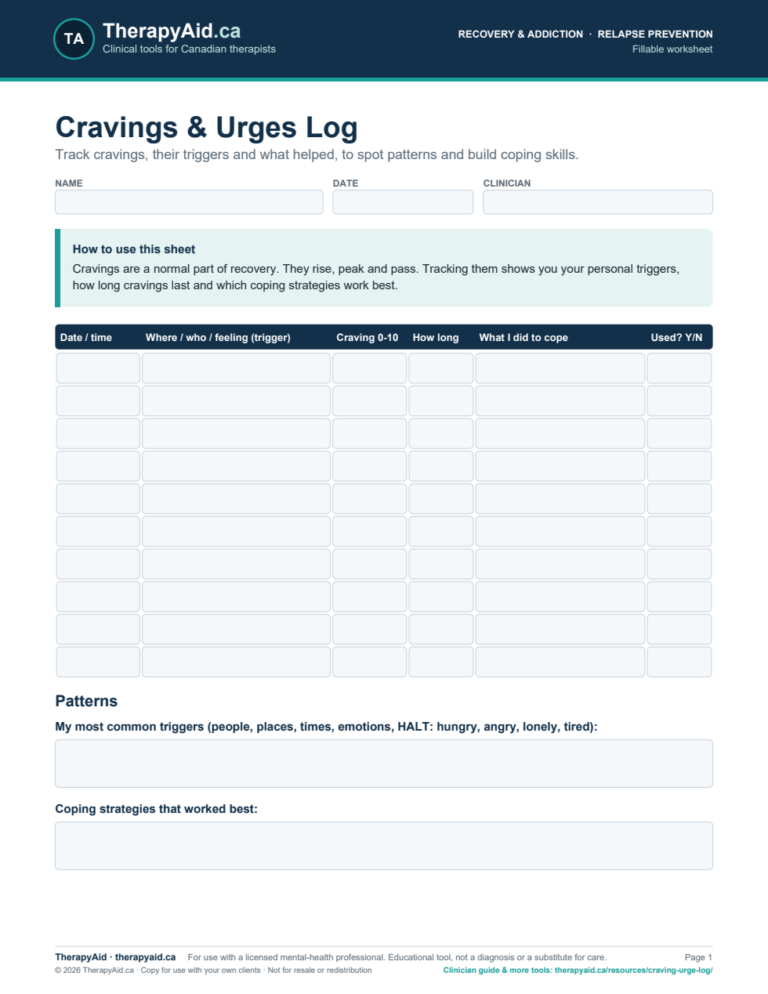
A recovery worksheet explaining the HALT check-in (hungry, angry, lonely, tired), with quick solutions for each and a weekly log linking states to cravings.
1-page fillable PDF · US Letter (prints on A4) · Relapse prevention
- Approach / concern
- Recovery & Addiction
- Technique
- Relapse prevention
- Format
- Fillable PDF, 1 page (US Letter / A4)
- Access
- Pro and Advanced plans (3-day free trial)
- For
- Licensed clinicians to use with clients
- Updated
- October 2026
Key facts
What is the HALT Check-In?
HALT is a widely used recovery-community acronym reminding people to check whether they are Hungry, Angry, Lonely or Tired, which are common states that increase vulnerability to cravings and relapse.
Why it works
Stress and negative emotional states increase vulnerability to drug use and relapse (Sinha, 2008). Identifying high-risk states and coping with them is central to relapse prevention (Marlatt & Donovan, 2005).
When to use it
- Substance use recovery
- Behavioural addictions
- Emotional eating
- Anyone prone to impulsive reactions
How to use it in session
- Introduce HALT as a quick pause.
- Practise the check-in when calm.
- Log HALT states and cravings daily.
- Notice patterns.
- Plan responses for each state.
Clinician tips
- Keep a HALT reminder on your phone lock screen.
- Combine with urge surfing.
- Use in family recovery too.
Worked example
Sharing with clients
Members can download the PDF to print or email, or copy a private client link from the download box. Your client opens the link and downloads the worksheet on any device. No client account is needed, and nothing your client writes is stored on TherapyAid.
Frequently asked questions
Where does HALT come from?
It’s a longstanding informal tool in 12-step and recovery communities, now used widely in addiction treatment.
Does HALT apply outside addiction?
Yes. It’s a helpful check for irritability, emotional eating and impulsive decisions too.
References
Marlatt, G. A., & Donovan, D. M. (Eds.). (2005). Relapse prevention: Maintenance strategies in the treatment of addictive behaviors (2nd ed.). Guilford Press.
Sinha, R. (2008). Chronic stress, drug use, and vulnerability to addiction. Annals of the New York Academy of Sciences, 1141, 105-130.
This worksheet is an educational tool for use by, or under the guidance of, a licensed or registered mental-health professional. It is not a diagnostic instrument or a substitute for clinical judgement. If a client is in crisis in Canada, call or text 9-8-8 or call 9-1-1.