Understanding ADHD: Strengths & Challenges
A plain-language ADHD psychoeducation handout covering attention, executive function and emotion regulation, with space to map personal strengths, challenges and supports.
1-page fillable PDF · US Letter (prints on A4) · Psychoeducation
- Approach / concern
- ADHD & Neurodiversity
- Technique
- Psychoeducation
- Format
- Fillable PDF, 1 page (US Letter / A4)
- Access
- Pro and Advanced plans (3-day free trial)
- For
- Licensed clinicians to use with clients
- Updated
- October 2026
Key facts
What is the Understanding ADHD: Strengths & Challenges?
ADHD is a neurodevelopmental condition involving persistent patterns of inattention and/or hyperactivity-impulsivity that affect functioning. It is associated with differences in executive function and emotion regulation, and with genuine strengths for many people.
Why it works
An international consensus statement summarizes strong evidence on the nature, causes and treatment of ADHD across the lifespan (Faraone et al., 2021). Psychoeducation is a recommended part of ADHD care (Barkley, 2015).
When to use it
- After an ADHD diagnosis
- Adults exploring a possible diagnosis
- Partners and families
- Students and workplaces
How to use it in session
- Explain ADHD in plain, non-blaming language.
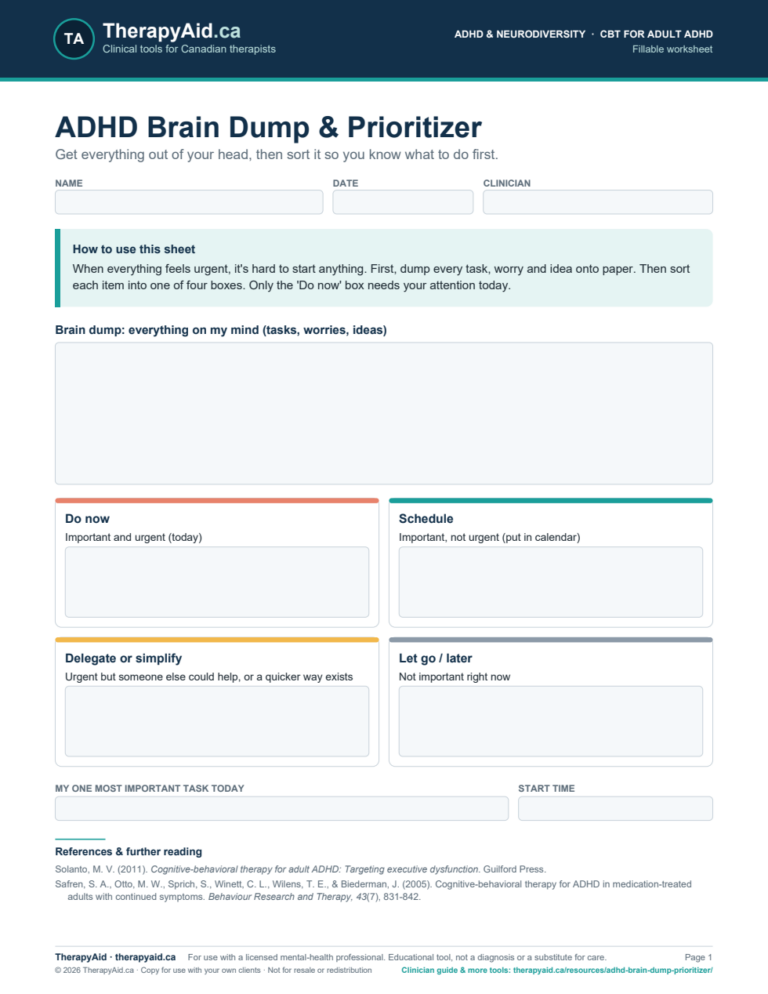
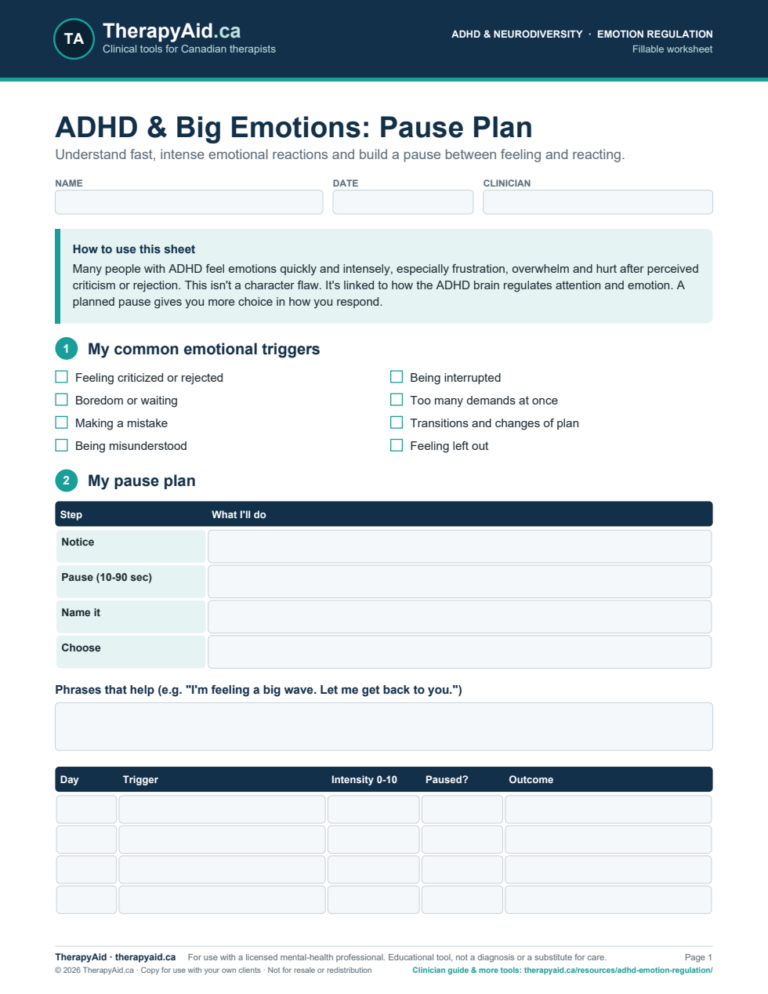
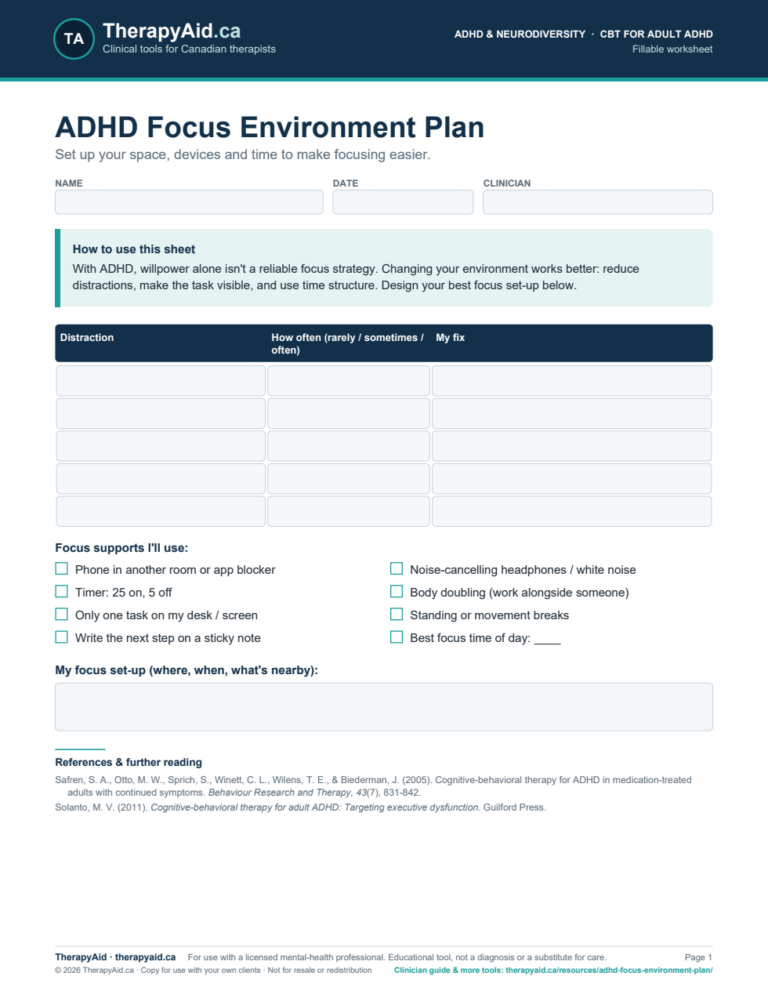
- Discuss the three areas.
- Map personal strengths and challenges.
- Identify supports and systems.
- Link to practical worksheets (task launch, planner).
Clinician tips
- Lead with strengths to reduce shame.
- Avoid diagnosing; refer for assessment when appropriate.
- Consider co-occurring anxiety, depression or learning differences.
Worked example
Sharing with clients
Members can download the PDF to print or email, or copy a private client link from the download box. Your client opens the link and downloads the worksheet on any device. No client account is needed, and nothing your client writes is stored on TherapyAid.
Frequently asked questions
Can adults have ADHD?
Yes. ADHD often continues into adulthood, and many adults are diagnosed later in life.
Is ADHD overdiagnosed?
Research suggests ADHD is a valid, well-studied condition. Careful assessment is important to diagnose accurately.
References
Faraone, S. V., Banaschewski, T., Coghill, D., Zheng, Y., Biederman, J., Bellgrove, M. A., et al. (2021). The World Federation of ADHD International Consensus Statement: 208 evidence-based conclusions about the disorder. Neuroscience & Biobehavioral Reviews, 128, 789-818.
Barkley, R. A. (Ed.). (2015). Attention-deficit hyperactivity disorder: A handbook for diagnosis and treatment (4th ed.). Guilford Press.
This worksheet is an educational tool for use by, or under the guidance of, a licensed or registered mental-health professional. It is not a diagnostic instrument or a substitute for clinical judgement. If a client is in crisis in Canada, call or text 9-8-8 or call 9-1-1.