Retirement Transition Plan
A transition worksheet for retirement that maps what work provided (structure, purpose, social contact, identity, activity) and how to replace it, plus hopes, worries and a routine anchor.
1-page fillable PDF · US Letter (prints on A4) · Transition counselling
- Approach / concern
- Life Transitions
- Technique
- Transition counselling
- Format
- Fillable PDF, 1 page (US Letter / A4)
- Access
- Pro and Advanced plans (3-day free trial)
- For
- Licensed clinicians to use with clients
- Updated
- October 2026
Key facts
What is the Retirement Transition Plan?
Retirement is a major life transition that can affect identity, social networks, daily structure and sense of purpose. Adjustment varies widely depending on personal resources, health, finances and how the transition is planned.
Why it works
Research on retirement shows that adjustment depends on individual, social and contextual resources, and that planning and maintaining meaningful roles support wellbeing (Wang & Shi, 2014).
When to use it
- Pre-retirement planning
- Difficult adjustment after retiring
- Involuntary or early retirement
- Couples adjusting to more time together
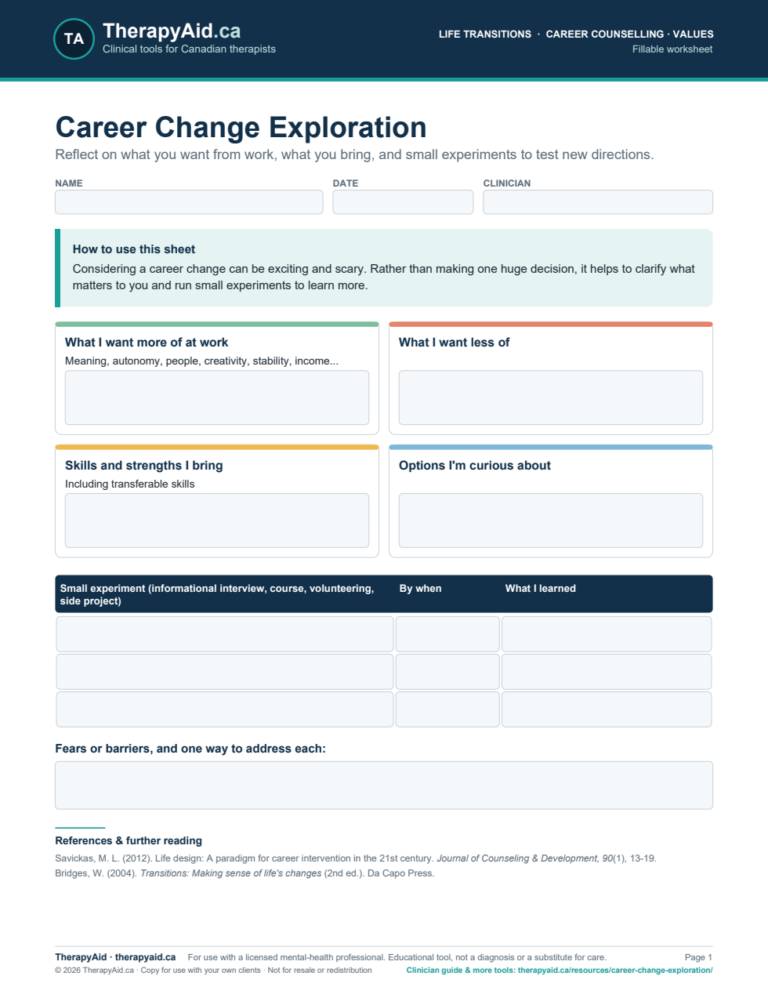
How to use it in session
- Explore what work provided beyond income.
- Plan replacements in each area.
- Discuss hopes and worries openly.
- Set up one weekly routine anchor.
- Review after a few months.
Clinician tips
- Volunteering and part-time roles can ease the transition.
- Discuss expectations with a partner.
- Screen for depression and loneliness.
Worked example
Sharing with clients
Members can download the PDF to print or email, or copy a private client link from the download box. Your client opens the link and downloads the worksheet on any device. No client account is needed, and nothing your client writes is stored on TherapyAid.
Frequently asked questions
Is it normal to feel low after retiring?
Yes, for some people, especially when retirement brings a loss of routine, identity or social contact. Planning helps, and support is available.
When should I start planning?
Ideally a year or more before retiring, though it’s never too late.
References
Wang, M., & Shi, J. (2014). Psychological research on retirement. Annual Review of Psychology, 65, 209-233.
This worksheet is an educational tool for use by, or under the guidance of, a licensed or registered mental-health professional. It is not a diagnostic instrument or a substitute for clinical judgement. If a client is in crisis in Canada, call or text 9-8-8 or call 9-1-1.