Consent & Boundaries Reflection
A private reflection worksheet for clarifying personal boundaries using yes, maybe and no lists, noticing discomfort signals and practising words for consent and check-ins.
1-page fillable PDF · US Letter (prints on A4) · Consent · Boundaries
- Approach / concern
- Sex Therapy
- Technique
- Consent · Boundaries
- Format
- Fillable PDF, 1 page (US Letter / A4)
- Access
- Advanced plan
- For
- Licensed clinicians to use with clients
- Updated
- October 2026
Key facts
What is the Consent & Boundaries Reflection?
Sexual consent is an ongoing, voluntary agreement that can be withdrawn at any time. Understanding one’s own boundaries and having language to communicate them supports safer, more satisfying intimate relationships.
Why it works
Research highlights that consent is complex, communicated in many ways and often misunderstood (Muehlenhard et al., 2016). Explicitly reflecting on boundaries and practising communication can increase confidence and clarity.
When to use it
- Sex therapy and relationship counselling
- Young adults and teens (adapted, age-appropriate)
- After sexual trauma, when the client is ready
- New relationships
How to use it in session
- Explain the principles of consent.
- Invite private completion of the lists.
- Explore discomfort signals.
- Practise boundary and check-in phrases.
- Provide resources for sexual violence support.
Clinician tips
- Keep the client in control of what’s shared.
- Be trauma-informed and go slowly.
- Use age-appropriate versions for adolescents.
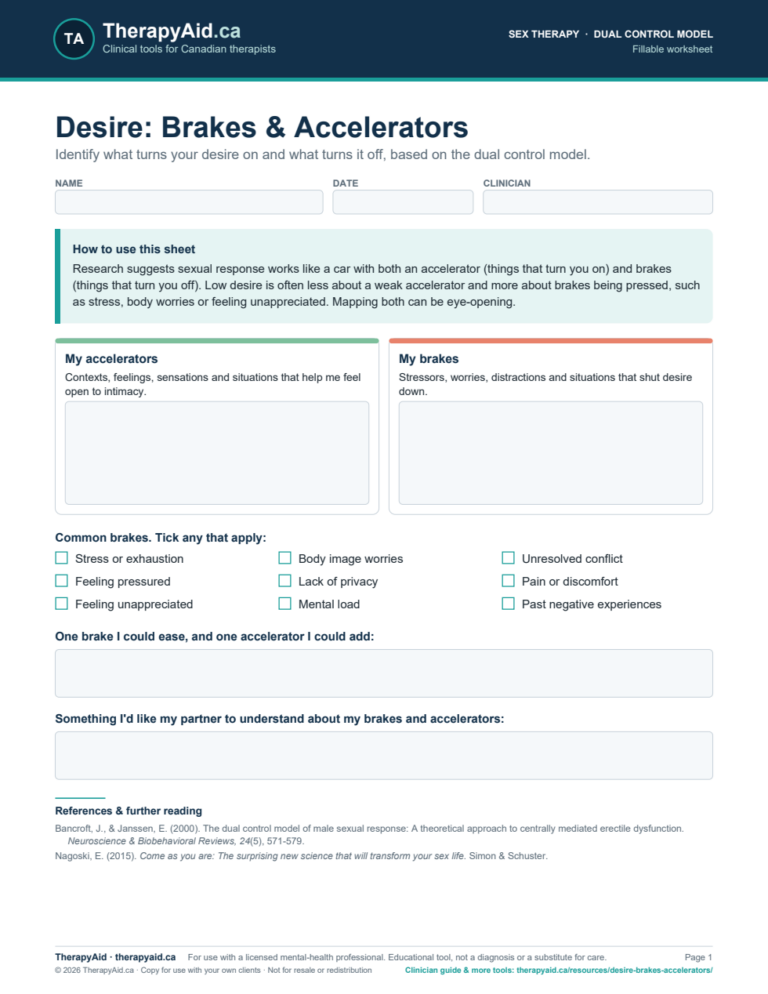
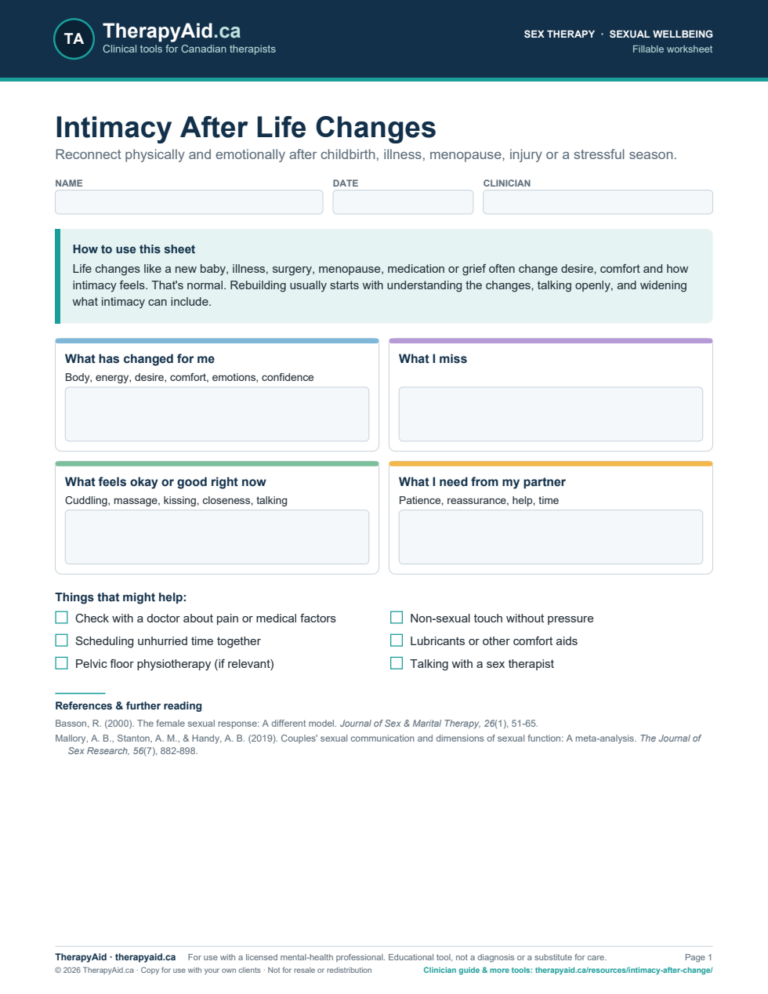
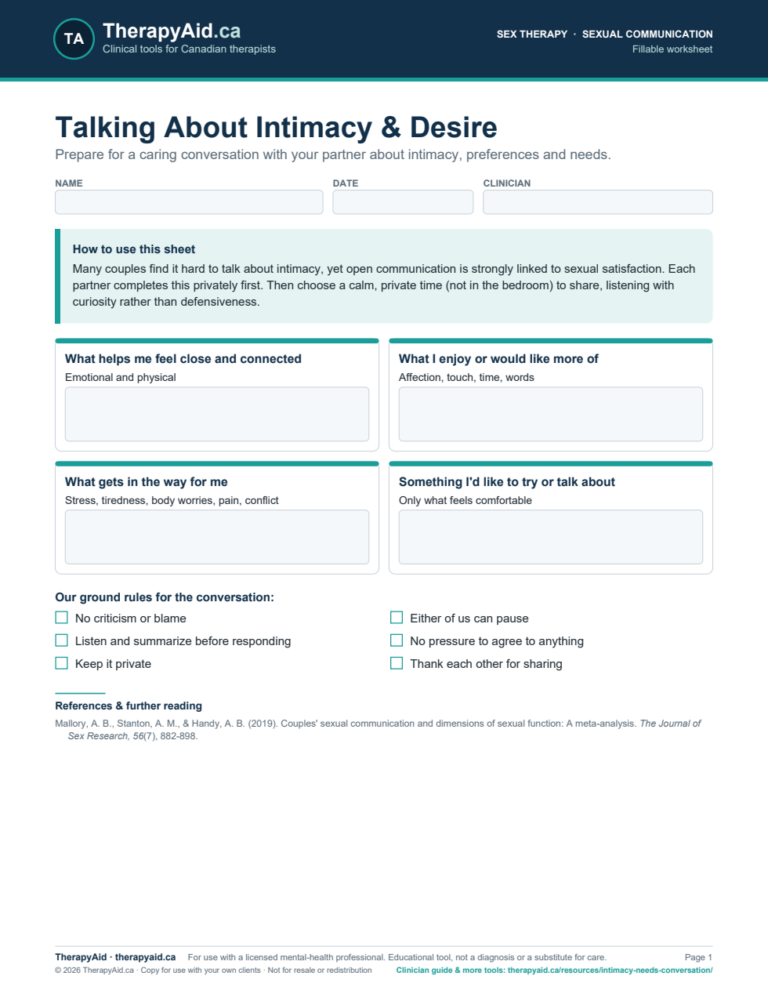
Worked example
Sharing with clients
Members can download the PDF to print or email, or copy a private client link from the download box. Your client opens the link and downloads the worksheet on any device. No client account is needed, and nothing your client writes is stored on TherapyAid.
Frequently asked questions
Can someone change their mind after saying yes?
Yes. Consent can be withdrawn at any time, and that must be respected.
Is this suitable for teens?
An age-appropriate version focusing on boundaries and healthy relationships can be used with adolescents.
References
Muehlenhard, C. L., Humphreys, T. P., Jozkowski, K. N., & Peterson, Z. D. (2016). The complexities of sexual consent among college students: A conceptual and empirical review. The Journal of Sex Research, 53(4-5), 457-487.
This worksheet is an educational tool for use by, or under the guidance of, a licensed or registered mental-health professional. It is not a diagnostic instrument or a substitute for clinical judgement. If a client is in crisis in Canada, call or text 9-8-8 or call 9-1-1.