Positive Attention & Praise Plan
A parent management worksheet for increasing specific praise and daily child-led special time, with a weekly log of praise counts, examples and child mood.
2-page fillable PDF · US Letter (prints on A4) · Parent management training
- Approach / concern
- Family Therapy
- Technique
- Parent management training
- Format
- Fillable PDF, 2 pages (US Letter / A4)
- Access
- Pro and Advanced plans (3-day free trial)
- For
- Licensed clinicians to use with clients
- Updated
- October 2026
Key facts
What is the Positive Attention & Praise Plan?
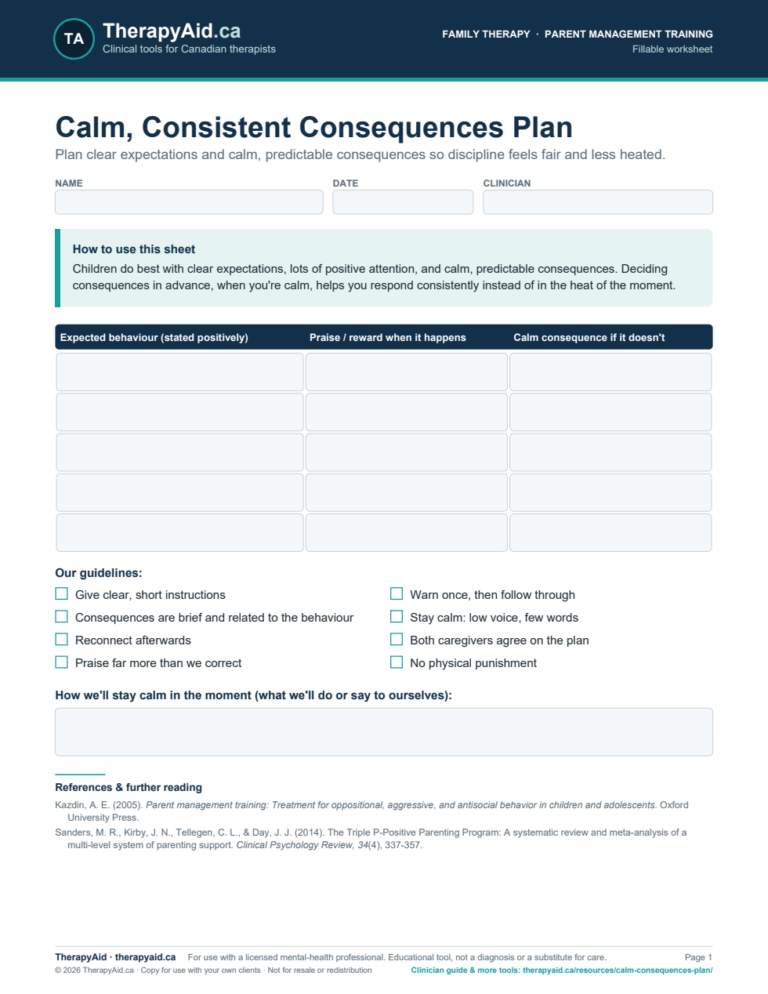
Positive attention strategies, such as labelled praise and brief daily child-led play, are core components of evidence-based parent management training. They strengthen the parent-child relationship and increase desired behaviours through positive reinforcement.
Why it works
Parent management training is among the best-supported interventions for child behaviour problems (Kazdin, 2005). Positive parenting programs improve child behaviour and parenting confidence (Sanders et al., 2014).
When to use it
- Oppositional or defiant behaviour
- Strained parent-child relationships
- ADHD-related behaviour challenges
- Parent coaching sessions
How to use it in session
- Identify target behaviours to increase.
- Teach and practise labelled praise in session.
- Set up 5-10 minutes of daily special time.
- Track praise and special time for a week.
- Review changes and troubleshoot.
Clinician tips
- Aim for many more praises than corrections.
- Special time shouldn’t be removed as punishment.
- Model praise in session with the parent.
Worked example
Sharing with clients
Members can download the PDF to print or email, or copy a private client link from the download box. Your client opens the link and downloads the worksheet on any device. No client account is needed, and nothing your client writes is stored on TherapyAid.
Frequently asked questions
Won’t praise spoil my child?
Specific praise for effort and behaviour encourages those behaviours. It’s different from excessive general praise.
What if my child misbehaves during special time?
Ignore minor misbehaviour; if it continues or is unsafe, calmly end special time and try again tomorrow.
References
Kazdin, A. E. (2005). Parent management training: Treatment for oppositional, aggressive, and antisocial behavior in children and adolescents. Oxford University Press.
Sanders, M. R., Kirby, J. N., Tellegen, C. L., & Day, J. J. (2014). The Triple P-Positive Parenting Program: A systematic review and meta-analysis of a multi-level system of parenting support. Clinical Psychology Review, 34(4), 337-357.
This worksheet is an educational tool for use by, or under the guidance of, a licensed or registered mental-health professional. It is not a diagnostic instrument or a substitute for clinical judgement. If a client is in crisis in Canada, call or text 9-8-8 or call 9-1-1.