Cravings & Urges Log
A relapse prevention log for recording cravings, their triggers, intensity, duration, coping strategies and outcomes, with space to identify patterns and effective strategies.
2-page fillable PDF · US Letter (prints on A4) · Relapse prevention
- Approach / concern
- Recovery & Addiction
- Technique
- Relapse prevention
- Format
- Fillable PDF, 2 pages (US Letter / A4)
- Access
- Pro and Advanced plans (3-day free trial)
- For
- Licensed clinicians to use with clients
- Updated
- October 2026
Key facts
What is the Cravings & Urges Log?
Craving monitoring is a core component of cognitive-behavioural relapse prevention. Recording when cravings occur, what triggers them and how they were managed builds awareness of high-risk situations and effective coping.
Why it works
Relapse prevention focuses on identifying high-risk situations and strengthening coping responses (Marlatt & Donovan, 2005). Seeing that cravings pass and that coping works builds self-efficacy, which predicts better outcomes (Witkiewitz & Marlatt, 2004).
When to use it
- Alcohol, drug and nicotine recovery
- Behavioural addictions such as gambling
- Early recovery
- After a lapse
How to use it in session
- Explain that cravings are normal and time-limited.
- Ask the client to log cravings as they happen.
- Review patterns and triggers together.
- Strengthen what works and add new strategies.
- Update the relapse prevention plan.
Clinician tips
- Recording a craving that didn’t lead to use is a success to celebrate.
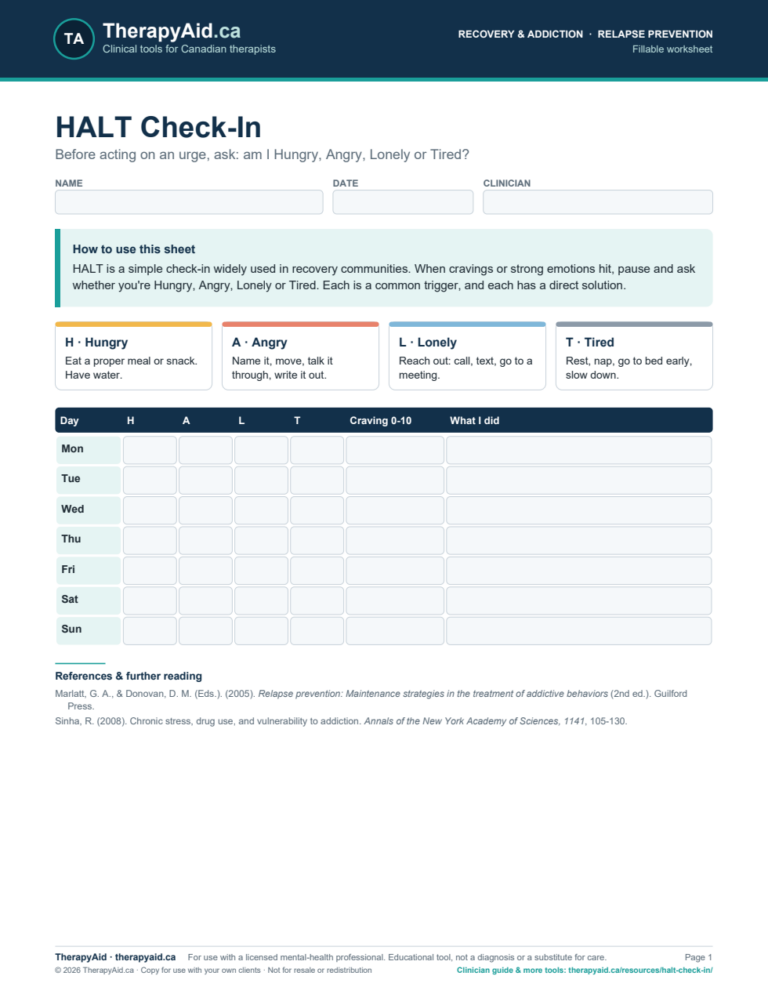
- HALT (hungry, angry, lonely, tired) is a useful prompt.
- Be non-judgemental about lapses recorded.
Worked example
Sharing with clients
Members can download the PDF to print or email, or copy a private client link from the download box. Your client opens the link and downloads the worksheet on any device. No client account is needed, and nothing your client writes is stored on TherapyAid.
Frequently asked questions
How long do cravings usually last?
Many peak and fade within 15-30 minutes if not acted on, although they vary.
What if I use after a craving?
Record it honestly. A lapse is information for your plan, not a failure.
References
Marlatt, G. A., & Donovan, D. M. (Eds.). (2005). Relapse prevention: Maintenance strategies in the treatment of addictive behaviors (2nd ed.). Guilford Press.
Witkiewitz, K., & Marlatt, G. A. (2004). Relapse prevention for alcohol and drug problems: That was Zen, this is Tao. American Psychologist, 59(4), 224-235.
This worksheet is an educational tool for use by, or under the guidance of, a licensed or registered mental-health professional. It is not a diagnostic instrument or a substitute for clinical judgement. If a client is in crisis in Canada, call or text 9-8-8 or call 9-1-1.