Health Anxiety Checking & Reassurance Log
A CBT self-monitoring worksheet for health anxiety that records sensations, checking and reassurance behaviours and anxiety over time, revealing the short-term relief and long-term cost.
2-page fillable PDF · US Letter (prints on A4) · CBT for health anxiety
- Approach / concern
- Anxiety & Panic
- Technique
- CBT for health anxiety
- Format
- Fillable PDF, 2 pages (US Letter / A4)
- Access
- Pro and Advanced plans (3-day free trial)
- For
- Licensed clinicians to use with clients
- Updated
- October 2026
Key facts
What is the Health Anxiety Checking & Reassurance Log?
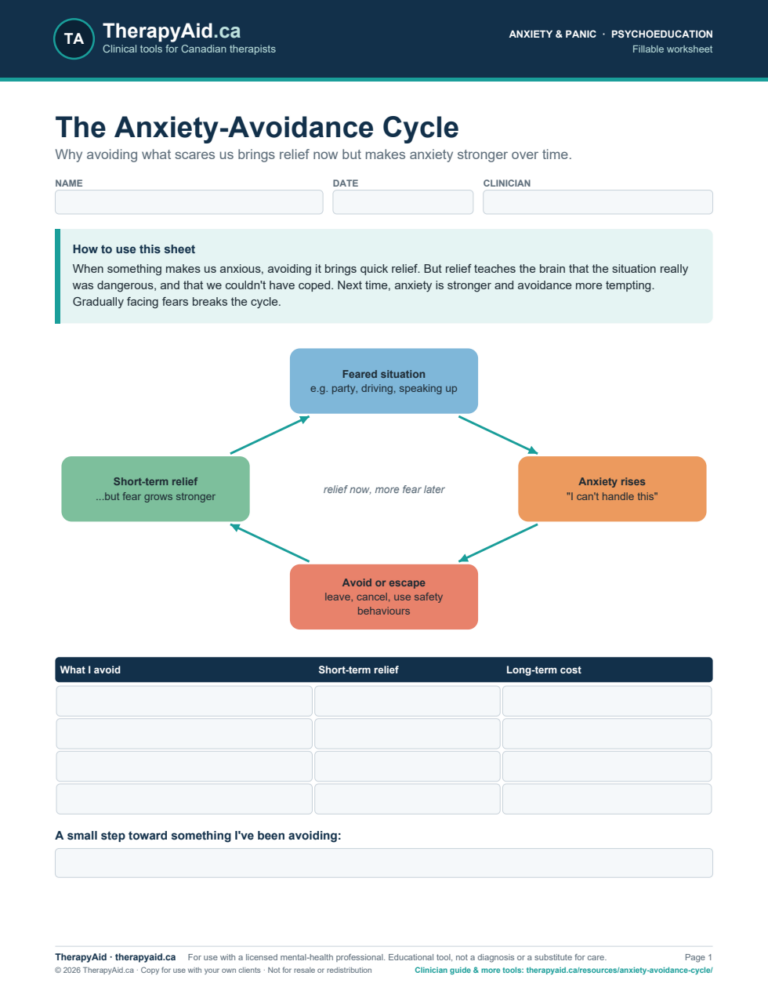
Health anxiety involves persistent worry about having or developing a serious illness. Safety behaviours such as body checking, online symptom searching and repeated reassurance-seeking maintain the problem by increasing attention to sensations and preventing new learning (Salkovskis & Warwick, 1986).
Why it works
CBT for health anxiety targets checking and reassurance behaviours and is an effective treatment (Taylor & Asmundson, 2004). Self-monitoring reveals the paradoxical effect of reassurance: relief now, more worry later.
When to use it
- Illness anxiety disorder (hypochondriasis)
- Somatic symptom concerns
- Cyberchondria (excessive symptom searching)
- Post-illness anxiety
How to use it in session
- Explain the cycle of checking and reassurance.
- Ask the client to log behaviours for one week.
- Compare short-term and longer-term anxiety.
- Choose one behaviour to reduce gradually.
- Coordinate with the family physician to set appropriate check-ups.
Clinician tips
- Agree on a reasonable plan for medical visits with the GP.
- Avoid giving medical reassurance in session.
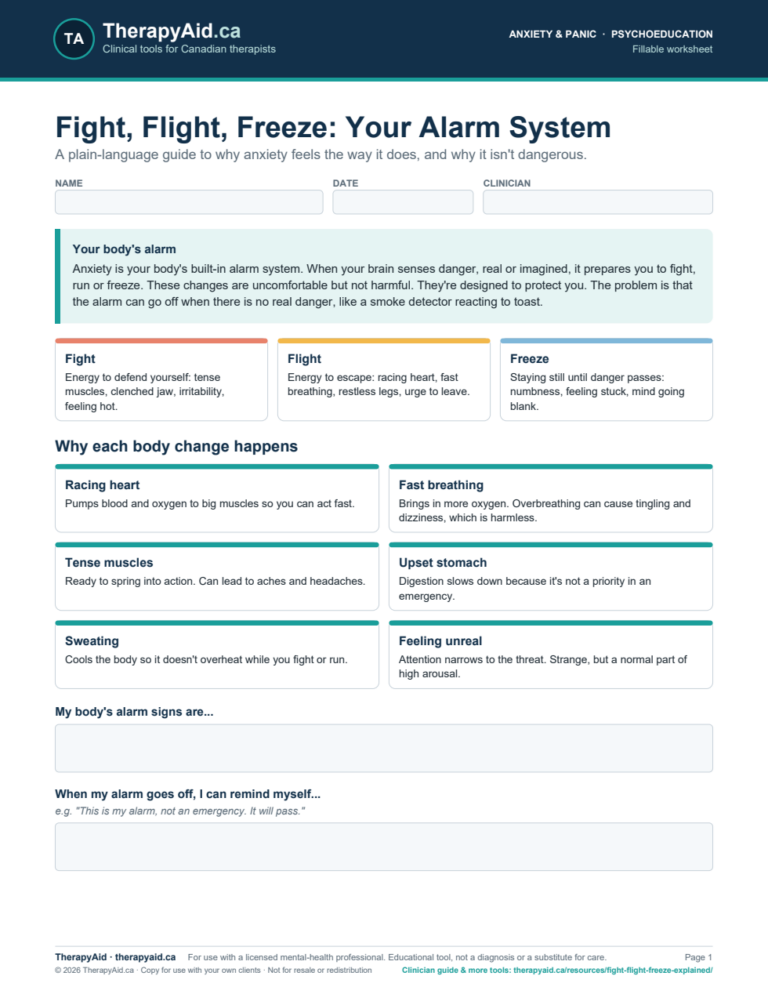
- Use attention experiments to show how focus amplifies sensations.
Worked example
Sharing with clients
Members can download the PDF to print or email, or copy a private client link from the download box. Your client opens the link and downloads the worksheet on any device. No client account is needed, and nothing your client writes is stored on TherapyAid.
Frequently asked questions
Should I stop seeing my doctor?
No. Work with your doctor to agree on appropriate, scheduled check-ups instead of frequent reassurance visits.
Why does googling make it worse?
Searching exposes you to rare, frightening possibilities and trains your brain to treat sensations as dangerous.
References
Salkovskis, P. M., & Warwick, H. M. C. (1986). Morbid preoccupations, health anxiety and reassurance: A cognitive-behavioural approach to hypochondriasis. Behaviour Research and Therapy, 24(5), 597-602.
Taylor, S., & Asmundson, G. J. G. (2004). Treating health anxiety: A cognitive-behavioral approach. Guilford Press.
This worksheet is an educational tool for use by, or under the guidance of, a licensed or registered mental-health professional. It is not a diagnostic instrument or a substitute for clinical judgement. If a client is in crisis in Canada, call or text 9-8-8 or call 9-1-1.