Grief Oscillation Log
A fillable grief worksheet based on the Dual Process Model. Clients track moments of loss-oriented and restoration-oriented coping and reflect on their balance and on continuing bonds.
2-page fillable PDF · US Letter (prints on A4) · Dual process model
- Approach / concern
- Grief & Bereavement
- Technique
- Dual process model
- Format
- Fillable PDF, 2 pages (US Letter / A4)
- Access
- Pro and Advanced plans (3-day free trial)
- For
- Licensed clinicians to use with clients
- Updated
- October 2026
Key facts
What is the Grief Oscillation Log?
The Dual Process Model of coping with bereavement (Stroebe & Schut, 1999) proposes that adaptive grieving involves oscillation between two kinds of stressors. Loss-oriented coping focuses on the relationship and the pain of the loss. Restoration-oriented coping focuses on secondary changes: new tasks, roles, identity, and taking time off from grief. Moving flexibly between the two is considered healthier than staying fixed in either.
Why it works
The model replaced older ‘stage’ theories that many bereaved people found did not fit their experience. It normalizes taking breaks from grief and helps clinicians spot when a client is stuck, either over-focused on the loss or avoiding it entirely. It works well alongside Worden’s tasks of mourning and continuing-bonds approaches.
When to use it
- Bereavement counselling
- Prolonged or complicated grief
- Non-death losses: divorce, health, migration
- Clients who feel guilty for ‘feeling okay’
- Clients who are avoiding grief through constant busyness
How to use it in session
- Explain the model with the two cards and ask where the client sees themselves.
- Assign the weekly log, noting one moment of each kind per day.
- Review patterns: is there oscillation, or a strong lean to one side?
- Gently invite movement toward the less-used side.
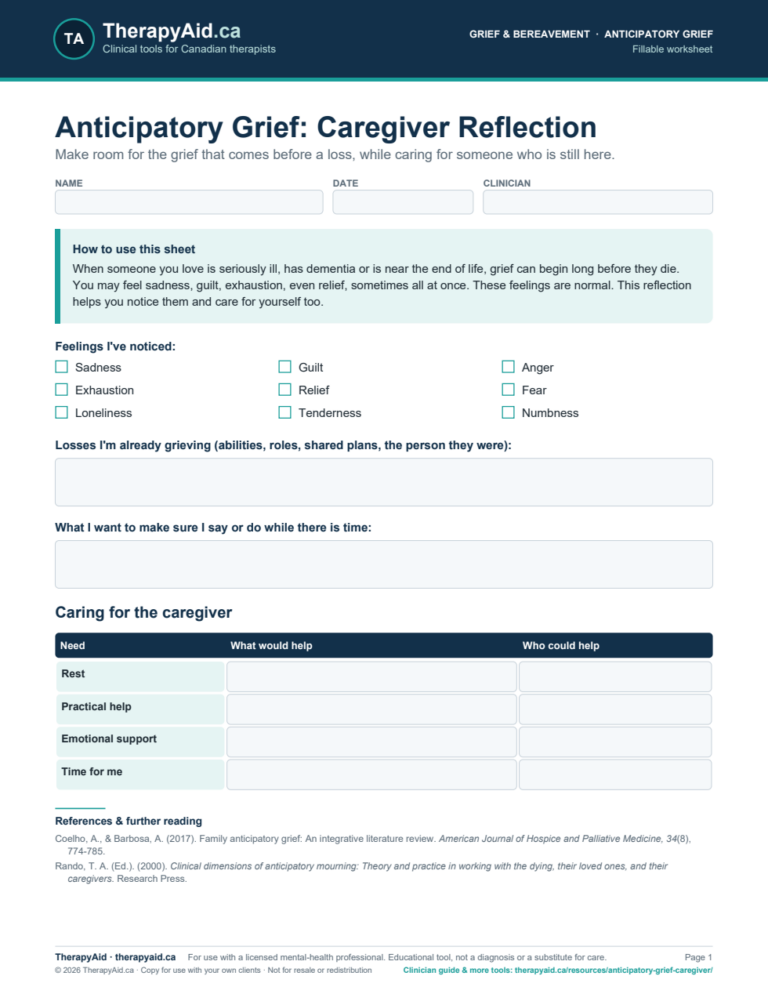
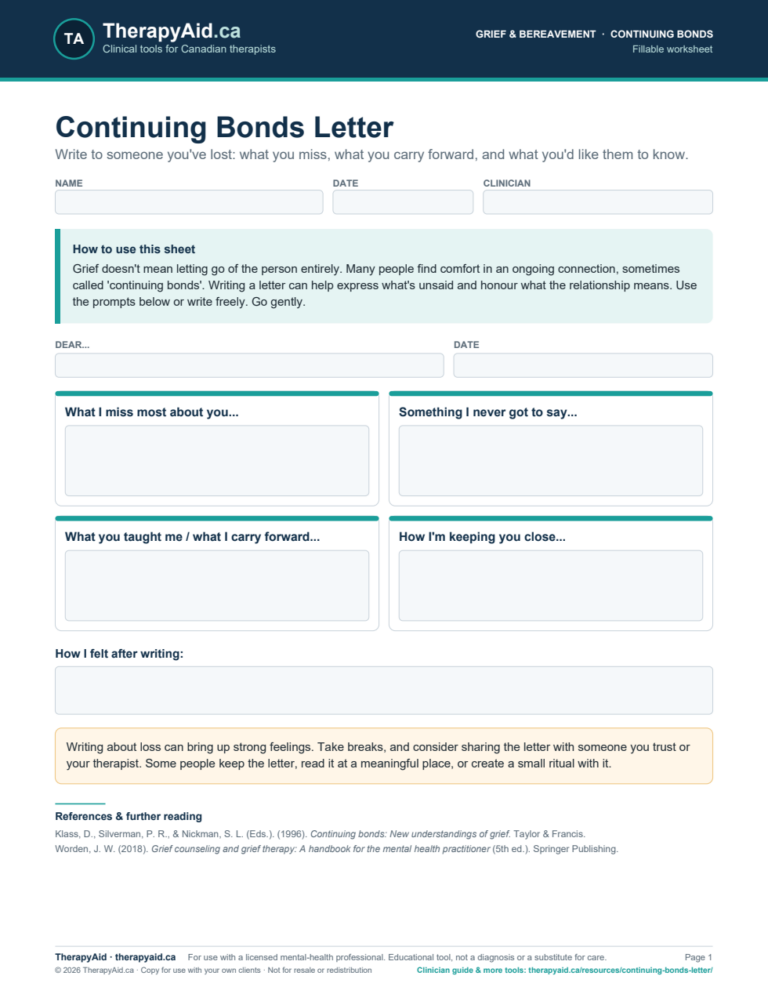
- Explore continuing bonds and meaningful ways to stay connected.
Clinician tips
- Validate breaks. Laughter or a good day does not mean the person is forgotten.
- Cultural and spiritual practices often provide both kinds of coping. Ask about them.
- Watch for signs of prolonged grief disorder and adjust treatment as needed.
Worked example
Sharing with clients
Members can download the PDF to print or email, or copy a private client link from the download box. Your client opens the link and downloads the worksheet on any device. No client account is needed, and nothing your client writes is stored on TherapyAid.
Frequently asked questions
Isn’t grief supposed to happen in stages?
The ‘five stages’ idea is widely known but not well supported as a fixed sequence. Most bereavement researchers now favour models like the Dual Process Model that allow for back-and-forth movement.
Can this be used for non-death losses?
Yes. The same oscillation applies to divorce, job loss, chronic illness and other major losses.
References
Stroebe, M., & Schut, H. (1999). The dual process model of coping with bereavement: Rationale and description. Death Studies, 23(3), 197-224.
Worden, J. W. (2018). Grief counseling and grief therapy: A handbook for the mental health practitioner (5th ed.). Springer Publishing.
Klass, D., Silverman, P. R., & Nickman, S. L. (Eds.). (1996). Continuing bonds: New understandings of grief. Taylor & Francis.
This worksheet is an educational tool for use by, or under the guidance of, a licensed or registered mental-health professional. It is not a diagnostic instrument or a substitute for clinical judgement. If a client is in crisis in Canada, call or text 9-8-8 or call 9-1-1.